
Guide
Best Starter Fusions in PVZ Fusion, Ranked for New Lawns
The starter fusions that repay their sun fastest in PVZ Fusion: Sunshooter, Spike-nut, Flame Peashooter, and the early hybrids worth your first almanac pages.
 By Felix Wagner, Mobile Game Reviewer
ALMANAC On this page
What Makes a Fusion a Starter Fusion
A starter fusion earns its place by three measures: both parents are cheap or already on your lawn, the hybrid does its job the moment it forms, and it stays useful after stronger recipes unlock. The PVZ Fusion download guide on the homepage lists the game's systems, but the ranking below is about sequencing: which hybrids to build in your first evenings, in which order, and why.
Notice what is not on this list: the spectacular tier-three plants. A beginner who saves for a Titan while basic lanes leak zombies is learning the game backwards. Starters are the plants that make saving possible, because they hold lanes and fund the bench at the same time.
Sunshooter and Spike-nut: The Foundation Pair
The Sunshooter is the economy engine: a Peashooter fused onto a Sunflower, firing while it generates sun. Two in the back columns change the math of every level, because your income now also shoots. Beside them, the Spike-nut, Spikeweed under a Wall-nut, is the wall that bites back. Zombies stop to chew and take damage the whole time, which quietly deletes the cheap front waves that used to cost you attention.
Build these two first in nearly every Adventure lawn. They are the pair the Sunshooter guide builds its placement patterns around, and together they free enough sun and attention to let you experiment with one new recipe per level, which is the fastest way to grow an almanac.
Flame Peashooter: Your First Crowd Answer
Rows in this game get crowded fast, and single-target peas fall behind. The Flame Peashooter, a Peashooter fused with Torchwood, solves it early: every pea catches fire and lands as splash damage. Against packed basic zombies it can out-perform hybrids twice its cost, because splash multiplies with crowd density.
Its weakness is the mirror of its strength. Against a lone armored zombie the splash is wasted and the fire does nothing special. Pair a flame lane with a focused single-target lane and the two cover each other's blind spots. That pairing instinct, one lane for crowds and one for armor, is the seed of every late-game lawn in the fusion tiers system.
Ice Lines: The Slow That Buys Time
Ice fusions rarely top a damage chart, and beginners underrate them for exactly that reason. A chilled zombie crosses the lawn more slowly, which means every other plant fires more times before contact. Slow is not damage, but it multiplies damage, and on the higher difficulties it is the difference between a fusion finishing in the back row and a zombie arriving first.
Start with one ice hybrid covering your busiest lane rather than spreading ice everywhere. Watch how the wave compresses, and notice which of your other plants suddenly look stronger. That observation will steer your mid-game recipes better than any tier list, including this one.
The Honest Case for the Humble Snow Line
Every ranking underrates the snow and ice fusions for the same reason: their work does not show up as damage. A slowed lane produces no satisfying pop. What it produces is time, and time in this game is secretly the strongest currency, because every plant you own is a damage-per-second machine whose total output is set by how long targets stay in range. Ice stretches the range without moving a single tile.
The snow line also forgives mistakes, which is a starter virtue no tier list weighs properly. A fusion that forms ten seconds late behind an ice line is a small embarrassment; the same delay on a naked lane is a lost lawn mower. Beginners building their first tier-two projects should route one ice hybrid to guard the construction zone as a matter of policy.
There is a final, quieter benefit. Ice makes waves bunch. Zombies that entered spread out arrive at your fire lane compressed, and splash damage, the other great starter idea, feeds on exactly that density. Ice and fire are not rival schools in this game. They are a supply chain, and the lawns that run both early are the ones still standing when Adventure stops being polite.
What to Build in Week One
A practical first week: Sunshooters and Spike-nuts everywhere, one Flame Peashooter lane for crowds, one ice hybrid for control, and one experimental slot per level where you try whatever the almanac suggests next. That shape holds Adventure comfortably and teaches all four starter ideas in real fights.
By the time Adventure starts demanding more, your bench will already contain the answers: the economy to afford tier-two builds, the wall craft to protect them while they form, and the habit of reading a wave before spending sun. The spectacular plants can wait. They will still be spectacular when your lawn can protect them.
One last starter note: keep a written shortlist, on paper or in your head, of the five recipes in this guide and the lanes each one owns. In the pressure of a new Adventure world, players do not rise to their intentions; they fall to their defaults. A shortlist is how these five become defaults. When a strange wave appears, the question stops being what do I do, and becomes which of my five answers fits, and that smaller question is answerable at speed.
Revisit the list monthly. Fusions graduate: a starter that carried your first world may become the ingredient of your first Advanced build, and the list should record the promotion. The ranking is a ladder of its own, and climbing it deliberately, plant by plant, is the quiet skill underneath every screenshot of a lawn full of wonders.
Quick Answers
Which fusion should a beginner build first?
The Sunshooter. It is cheap, the tutorial teaches it, and a defender that also makes sun improves every minute of every level that follows.
Are high-tier fusions better than starters?
Stronger per tile, but not better early. A Titan cannot help a lawn that cannot afford it or protect it while it forms. Starters make high tiers possible.
How many starter fusions does a lawn need?
Most early lawns run two Sunshooters, one or two Spike-nuts, one crowd lane, and one control plant. The rest of the tiles can stay flexible for experiments.
Where can I see every recipe I have found?
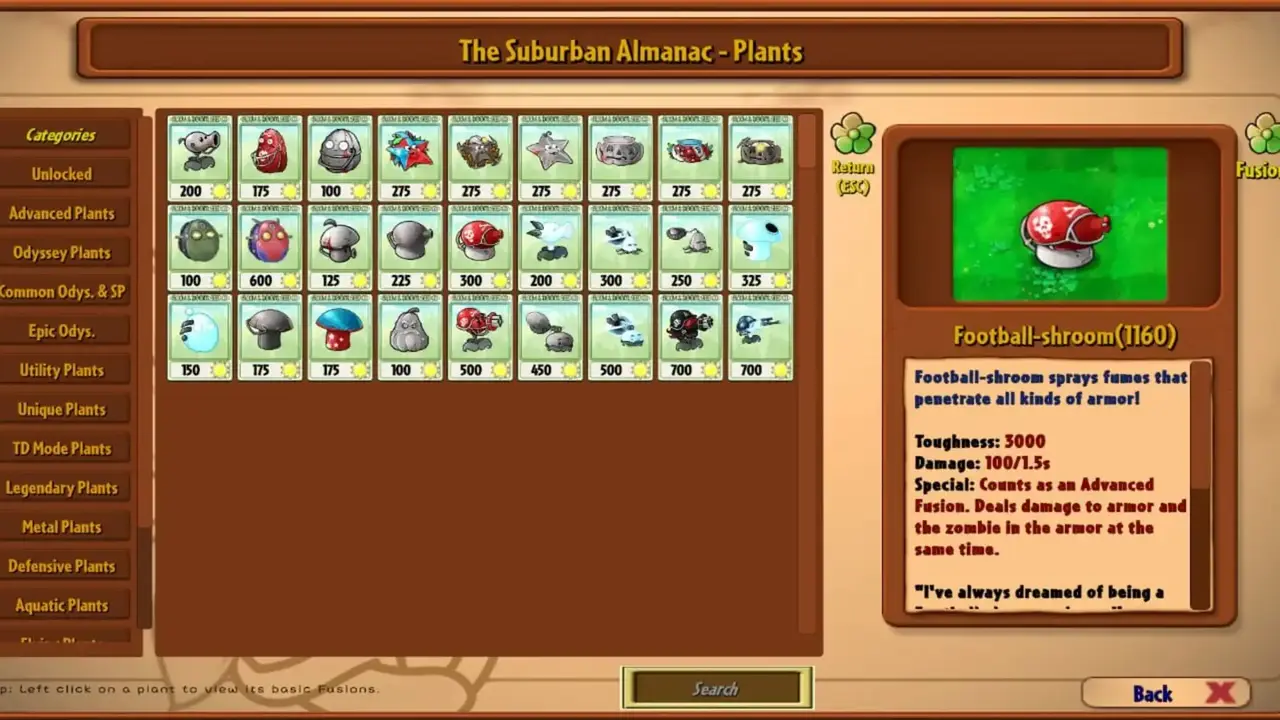
In the in-game almanac. It records each discovered fusion and hints at undiscovered ones, so it doubles as your recipe book and your progress tracker.